Business Overview & Launch Plan
Platform Screenshots
Live screenshots taken directly from your machine. This is what the platform looks like right now — not a mockup.
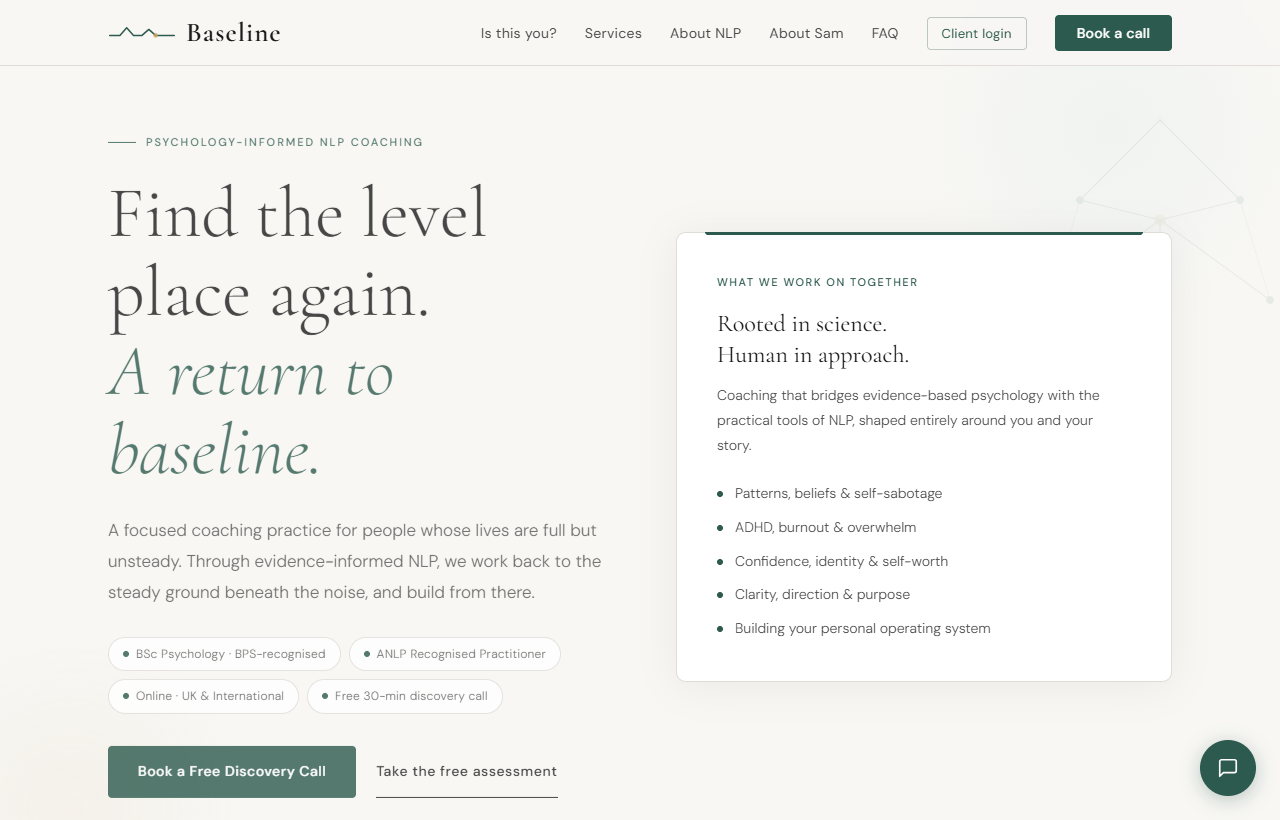
The main public-facing website. Single scrollable page — opens directly by double-clicking index.html. No server, no build step.
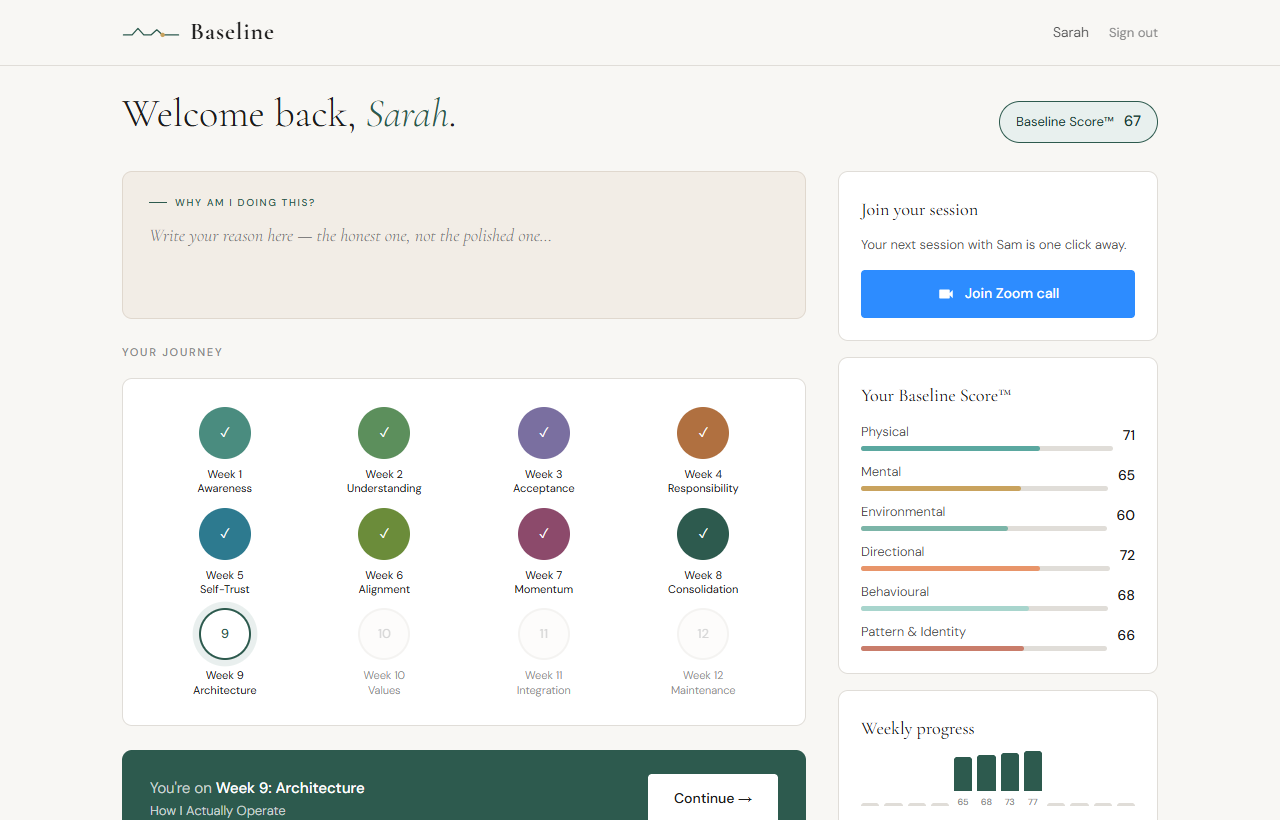
What a Baseline Reset client sees when they log in. Showing demo client James, currently on Week 4 — Responsibility. Baseline Score 52, dimension breakdown visible in the sidebar, weekly progress tracked.
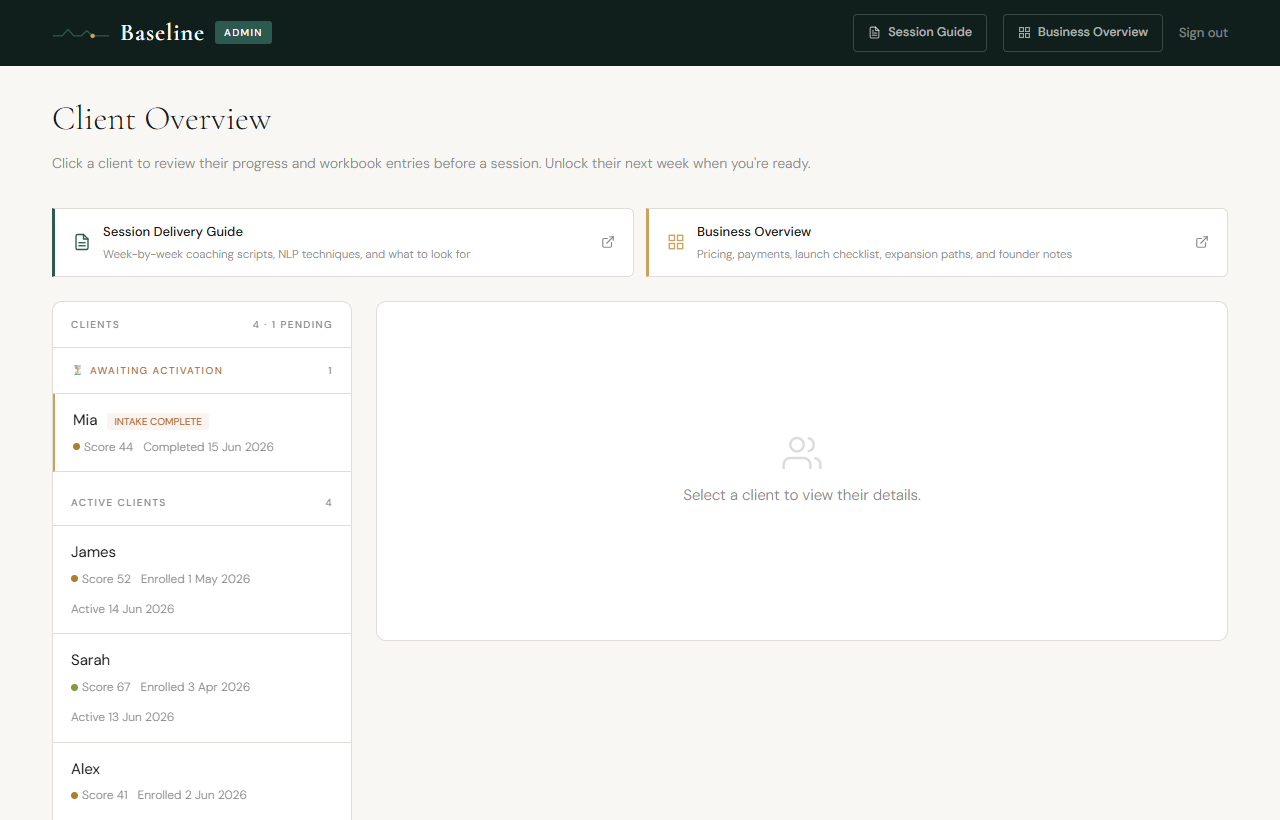
Sam's view of all clients. Left panel shows clients sorted by status — Mia is awaiting activation (intake complete, score 44), active clients below. Click a client to review their entries and manage their week progression.
Launch Status
Where things stand right now. Everything that required building has been built. What's left is account setup — external services that plug into the existing code.
Platform — 95% Complete
The full coaching platform is built: marketing website, client portal, admin dashboard, 12-week programme modules, Baseline Index assessment, Operating System builder, AI chat widget, brand identity, and all coaching framework documentation. Baseline Coaching Ltd is registered, the domain is live, sam@baselinecoaching.co.uk is active, Cal.com booking links are set, the headshot is in place, and Vercel serverless functions are configured. Everything runs and is testable right now.
The site is live and deployed. What remains is two external setup steps — Stripe for one-off payments and GoCardless for instalment plans — plus confirming Supabase and the Anthropic API key are properly live. None require touching the code.
What's done
Marketing website · Client portal · Admin dashboard (with Intake + OS Draft tabs) · 12 weekly modules · Baseline Index · OS builder (with Sam's feedback banner) · AI chat widget · Brand identity · Coaching framework · Client materials · Crisis safeguarding · Supabase schema · Vercel functions (api/chat.js, api/subscribe.js) · Baseline Coaching Ltd registered · Domain (baselinecoaching.co.uk) · Professional email (sam@baselinecoaching.co.uk) · Formspree contact form (active) · Cal.com booking links (discovery call + coaching session) · Headshot (assets/sam.jpg)
What's outstanding
Stripe account + full-payment links · GoCardless account + instalment plans · Confirm Supabase schema was actually run + admin login works · Confirm Anthropic API key is live (AI chat)
Launch Checklist
Everything needed before going live, with step-by-step instructions for each one. Tick items off as you complete them — your progress saves automatically in the browser.
Launch Week Copy
Ready-to-use copy for the marketing plan's own top-priority actions (warm outreach first, LinkedIn second), plus the Cal.com confirmation email flagged as a Week 1 fix. Copy-paste and personalise before sending.
1. Warm outreach — 50 personal messages
Two variants. Send the personal one to people who know you; the second to acquaintances/weaker ties. Change a line or two per person so it doesn't read templated.
Close contacts
"Hey [Name] — random one, but I wanted to tell people directly rather than just post about it: I've spent the last while training as an NLP practitioner and building a proper coaching programme on top of my psychology background. It's called Baseline. Just started taking clients.
Not asking you for anything — just wanted you to hear it from me rather than see it online. If you ever know anyone who's smart, capable, and just stuck in a rut they can't quite name, I'd love an intro. Free 30-min call, no pressure either way.
Hope you're doing well x"
Wider network / weaker ties
"Hey [Name], hope you're well. Wanted to let you know I've launched something — Baseline, a psychology-informed NLP coaching practice. 12-week 1:1 programme for people who look fine on paper but feel stuck in patterns they can't shift on their own.
Early days, so I'm reaching out personally rather than just posting. If it's relevant to you or someone you know, there's a free 30-min discovery call — no pitch, just a proper conversation: [cal.com link]
Either way, good to reconnect."
2. LinkedIn founder-story post
Matches the plan's cadence guidance: soft CTA, no hard sell, ends with an invitation not a pitch.
At 21 I opened a coffee shop in Glasgow with £5,000 I'd saved up. No investors, just a lease and a lot of early mornings. I built it up slowly — regulars, a team, an actual functioning business.
COVID took it in about six weeks.
I was diagnosed with ADHD as a kid, back when almost nobody talked about it. I studied psychology partly to understand myself — why some days I could focus for six hours straight, and other days I couldn't answer an email.
When the coffee shop folded, I wasn't short on intelligence or work ethic. I had plenty of both. What I didn't have was a way of operating that could survive something that big hitting me sideways. Nobody had ever taught me that. I built it myself, badly, over a long time.
Somewhere in psychology, NLP training, and rebuilding my own life, I noticed the same thing everywhere — in that shop, in friendships, in myself: capable people, quietly stuck. Not broken. Stuck.
That's why I built Baseline. A structured, psychology-informed coaching programme for people who are doing everything "right" on paper and still feel like they're pushing a boulder uphill.
If that's familiar — even a little — I'm doing free 30-minute calls this month. No pitch, just a proper conversation. Link's in the comments / my bio.
3. Cal.com discovery call confirmation email
Sets tone before the call, reduces no-shows — the marketing plan flags the gap between booking and showing up as "where doubt creeps in."
Subject: Your Baseline discovery call — what to expect
Hi [First name],
You're booked in for [date/time] — really looking forward to it.
This is a proper 30-minute conversation, not a sales call. I'll ask what's actually going on for you, you can ask me anything about how Baseline works, and by the end we'll both know honestly whether this is a good fit. If it's not, I'll say so — and I'll try to point you somewhere better if I can.
Nothing to prepare. Just show up as you are.
Talk soon,
Sam
[Zoom link] · Need to reschedule? [Cal.com reschedule link]
What's Built
Every component of the platform that already exists and is working. This isn't a to-do list — it's a record of what's been created. Most coaching businesses have a website and a Calendly link. This is considerably more than that.
Marketing Website
A single scrollable HTML page that opens directly in a browser — no build step, no server required. Eight sections: hero, "Is this for you?", the Baseline Reset process, services, NLP explainer, About Sam, FAQ, and contact. Includes an animated ECG pulse line in the header, smooth scroll animations, an AI chat widget, and crisis safeguarding in the footer with country-specific crisis lines (UK, US, Canada, Australia, Ireland) that update automatically based on the visitor's location.
CompleteClient Portal
An interactive programme dashboard where Baseline Reset clients log in, track their progress, and complete their weekly work. Built in vanilla JavaScript using ES modules — no framework overhead. Clients see their Baseline Score, their week progression (8 circles showing locked/current/completed state), a "my why" card, and quick links to the workbook, OS builder, and session join link. All entries auto-save to Supabase. Runs in demo mode with sample clients until connected to a live database.
CompleteAdmin Dashboard
Sam's coach view showing every enrolled client. A left sidebar lists clients sorted by status — "awaiting activation" and "active clients". Clicking a client opens their full profile with three tab types: Intake tab — Sam enters the client's six dimension scores after the discovery call, writes a personalised Baseline Summary that appears on the client's awaiting screen; Week tabs — one per unlocked week, showing all client workbook entries + private session notes + a client-visible note field; OS Draft tab — shows the client's full 8-chapter Operating System draft and lets Sam write a review note that appears as a highlighted banner in the client's OS builder. Week unlock/lock controls on each tab. Everything auto-saves.
CompleteBaseline Index™
A 90-question psychometric-style diagnostic taken by every client before the programme begins. 15 questions per dimension across six areas: Physical, Mental, Environmental, Directional, Behavioural, and Pattern & Identity. Each question scores 1–10; dimension scores average to a Baseline Score™ out of 100. Five score bands: Critical Drift (0–39), Significant Drift (40–55), Moderate Drift (56–70), Aligned (71–85), and Strongly Aligned (86–100). The score is taken again at Week 12 — giving a concrete before/after comparison. This measurable outcome is what most coaching practices don't have.
CompleteBaseline Method™ Framework
The complete coaching delivery manual — 612 lines covering the programme philosophy, the three levels of stuckness (psychodynamic, NLP, and behavioural lenses), the Baseline Change Equation, and detailed week-by-week delivery notes for all 12 weeks. Each week includes: rationale, coaching objectives, NLP methodologies, psychodynamic themes, core exercises with instructions, reflection questions, what to watch for, and the expected breakthrough. Written to coaching-training standard. This document is the foundation that makes the method licensable and teachable beyond one practitioner.
Complete12 Weekly Programme Modules
Twelve fully built interactive HTML pages — one per week of the Baseline Reset. Each module includes the week's declaration, theme, core teaching content, exercises (with text input fields that save to the database), and reflection questions. Weeks are locked by default; Sam unlocks them from the admin side one at a time to control the pacing. The three-phase progression is: Phase 1 (The Audit) Weeks 1–4 → Phase 2 (The Pattern Work) Weeks 5–8 → Phase 3 (The Operating System) Weeks 9–12.
CompleteClient Workbook & OS Builder
The workbook (portal/workbook.html) shows a complete view of all 12 weeks' exercises and the client's own written entries — printable at any point as a PDF record of the full journey. The Operating System builder (portal/os-builder.html) is used across Weeks 9–12 to construct the client's personalised OS document: identity statement, core values, decision filters, drift warning signs, recovery protocol, and more across 8 chapters. If Sam has left a review note via the OS Draft tab in admin, the client sees it as a highlighted green feedback banner at the top of the OS builder. Both tools are built and working.
AI Chat Widget
A fixed chat button in the bottom right of the website, powered by the Anthropic Claude API via a Vercel serverless function (api/chat.js). The chat has a system prompt that knows the programme, the services, the booking flow, and Sam's approach. It can answer questions, explain the Baseline Reset, and route people to book a discovery call. Crisis safeguarding is hard-coded: certain keywords (crisis, suicidal, self-harm) trigger immediate redirection to appropriate support resources rather than continued conversation. Needs an Anthropic API key in Vercel environment variables to activate; falls back to a static message without one.
Brand Identity
ECG pulse mark as the primary brand symbol — a monitoring line with a gold dot, representing stability and the return to baseline. Forest green primary colour (#2d5a4e), warm beige background (#f8f7f4), gold accent (#C9A35E) used only on the pulse dot and tagline. Full CSS design token system (11 custom properties) applied consistently across website and portal. Cormorant Garamond for headings (elegant, editorial), DM Sans for body copy (clean, modern). Logo files at assets/logo-primary-dark.png.
Client Materials
Five documents in the baseline_method/handouts/ folder: (1) Programme overview — client-facing one-pager explaining what the Baseline Reset is. (2) 90-question Baseline Index™ — printable assessment version. (3) 12-week client workbook — all exercises and reflections. (4) Client Brief template — completed by Sam personally for each client before Week 1 begins, identifying their priority areas and the patterns the programme will target. (5) Operating System template — the final deliverable built in Weeks 11–12. Available in both markdown and HTML formats.
Pricing
Prices are never shown on the website — they are discussed on the discovery call. This is deliberate. The first conversation should be about fit and understanding what the client needs, not about a number on a page that they haven't yet understood the context for.
| Service | Format | Price | Purpose |
|---|---|---|---|
| Discovery Call | 30 min · Online · Free | Free | The entry point for all services. A 30-minute diagnostic conversation — not a sales pitch. The client explains what's going on; Sam explains how he works; together they decide if coaching is the right fit and which format makes sense. No pressure and no obligation. This call converts well precisely because it isn't a pitch. Low barrier, high trust. |
| Single Session | 60 min · Online | £75 | A focused session for someone who has a specific situation, decision, or stuck pattern they want to work through. No long-term commitment — just targeted, practical coaching for one clear outcome. Entry point for clients who aren't ready for the full programme. Often leads to Baseline Reset once they experience the work. |
| Baseline Reset™ | 12 weeks · Weekly 1:1 calls · Online | £1,800 | The flagship programme. 12 weekly 1:1 sessions across three phases, a personalised Client Brief written by Sam, interactive weekly modules, and the Operating System deliverable. Designed for real, lasting change from the inside out. Standard rate (post-founding). Founding clients: £600. Discuss in the context of what's included — see the value breakdown below. |
Founding Client Rate
A time-limited introductory rate for the first clients through the door — before testimonials, before social proof, before the practice is established. Early clients take a degree of risk on an unproven track record; in return, they get access at a meaningful reduction. Once you have 5–10 clients and their results, the price moves to standard.
The principle: reward early adopters honestly.
The founding rate is £600 — a third of the £1,800 standard rate. This is a significant reduction, and it's intentional. Early clients take a real risk on an unproven track record. In return they get 12 weeks of direct access at a rate that acknowledges that. Once you have 5–10 clients and results to show, the price moves to standard.
The framing is always "Founding Client Rate" — never "discount", never "sale". Founding client pricing is a legitimate and respected business practice. You're rewarding early adopters, not clearing stock.
| Service | Founding Rate | Standard Rate | Saving |
|---|---|---|---|
| Single Session60 minutes · Online | £55 | £75 | £20 off (27%) |
| Baseline Reset™Full 12-week programme | £600 | £1,800 | £1,200 off (67%) |
Payment Processing
Two tools, not one. Stripe for one-off payments and single sessions. GoCardless for all instalment plans. Both are free — no monthly subscription, ever. You pay a small percentage per transaction only. Here's exactly what that costs, to the penny.
Stripe vs GoCardless — why both, not one
Stripe is the best tool for one-off card payments and integrates natively with Cal.com for session bookings. But for recurring instalments, Stripe charges an extra 0.7% Billing fee on top of its standard rate — making it 2.2% + 20p per subscription payment.
GoCardless collects via UK Direct Debit instead of card. It costs less per recurring payment, and critically, Direct Debit mandates are much harder for clients to cancel than a card — protecting you from non-payment. Neither tool has a monthly fee. You pay per transaction only.
Stripe
GoCardless
£75 — Single Session (60 min)
Collected automatically inside Cal.com at the point of booking via Stripe. Client picks a slot, pays, and receives confirmation — no invoice, no chasing.
£1,800 — Baseline Reset (full) / £600 founding
A Stripe Payment Link sent by email after the discovery call, once the client has confirmed they want to proceed. They pay, Sam activates their portal account, Week 1 unlocks.
Exactly what you get charged — and what you receive
Every scenario worked out to the penny. GoCardless fees include 20% VAT (Stripe fees do not attract VAT for you).
| Payment | Tool | Charged to client | Your fee | You receive |
|---|---|---|---|---|
| Single Session £75Standard rate, via Cal.com | Stripe | £75.00 | £1.33 | £73.67 |
| Single Session £55Founding rate | Stripe | £55.00 | £1.03 | £53.97 |
| Baseline Reset £1,800Standard rate, full payment | Stripe | £1,800.00 | £27.20 | £1,772.80 |
| Baseline Reset £600Founding rate, full payment | Stripe | £600.00 | £9.20 | £590.80 |
| 3 × £600Standard, per payment (£1,800 total) | GoCardless | £600.00 | £4.00 incl. VAT (capped) | £596.00 → £1,788 total |
| 6 × £300Standard, per payment (£1,800 total) | GoCardless | £300.00 | £3.84 incl. VAT | £296.16 → £1,776.96 total |
| 12 × £150Standard, per payment (£1,800 total) | GoCardless | £150.00 | £2.04 incl. VAT | £147.96 → £1,775.52 total |
| 3 × £200Founding rate, 3-month plan | GoCardless | £200.00 | £2.40 incl. VAT | £197.60 → £592.80 total |
| 12 × £50Founding rate, 12-month plan | GoCardless | £50.00 | £0.84 incl. VAT | £49.16 → £589.92 total |
How many clients do you need before these tools are worth it?
Zero. Neither Stripe nor GoCardless has a monthly subscription fee. You pay nothing until a payment happens — and even then it's a tiny slice of money you've already received. There is no threshold to justify. They're free from day one.
| Scenario (per month) | 1 client | 5 clients | 10 clients |
|---|---|---|---|
| All single sessions (£75)Stripe via Cal.com | £1.33 | £6.65 | £13.30 |
| All full Baseline Reset (£1,800)Stripe Payment Link | £27.20 | £136.00 | £272.00 |
| All on 3-month plan (£333/collection)GoCardless — one collection per client per month | £4.24 | £21.20 | £42.40 |
| Mixed: 5 full Reset + 5 sessionsRealistic working month at standard rates | — | £142.65 | — |
Baseline Reset — all payment options
One-off payments collected via Stripe. All instalment plans via GoCardless (Direct Debit). Mentioned verbally on the discovery call — offer the plan that fits the client.
Plans, upgrades, and when (if ever) you need a paid tier
Stripe — no upgrade ever needed
Stripe has no monthly fee, ever. The only costs are per transaction: 1.5% + 20p for one-off payments. There is no Stripe paid plan that makes sense for Baseline Coaching's volume. Disputes cost £15 each (refunded if won) — another reason to use GoCardless for instalments, where Direct Debit disputes are far rarer than card chargebacks.
GoCardless — three tiers, no monthly fee on any of them
| Plan | Rate | Cap per payment | Verdict |
|---|---|---|---|
| Standard | 1% + 20p | £4.00 (+ VAT) | Use this. Always. Sufficient indefinitely at Sam's volume. |
| Advanced | 1.25% + 20p | £5.00 (+ VAT) | Higher rate — no reason to choose this. |
| Pro | 1.4% + 20p | £5.60 (+ VAT) | Enterprise features — irrelevant at this scale. |
Standard includes unlimited payments, automatic retry on failed collections, email notifications, and a client-facing mandate flow. You will never need to upgrade.
Cal.com — free plan works
Cal.com's free plan includes Stripe payment integration. No upgrade needed to collect session payments at booking. Paid plan (~£9/month) adds team features and custom branding — not needed at launch.
How GoCardless protects you against non-payment on instalments
With Stripe card subscriptions, a client can cancel their card, let it expire, or raise a chargeback. Stripe retries 3–4 times then stops. A determined non-payer can walk away with no consequences beyond a few emails.
With GoCardless Direct Debit, the client signs a Direct Debit mandate — a formal bank-level authorisation. GoCardless pulls from their bank account on the agreed date. To stop it, the client must contact their bank and formally cancel the mandate — a deliberate act with a paper trail that takes real effort. Impulsive ghosting doesn't work.
If a payment fails: GoCardless automatically retries and notifies both parties. Most failures are accidental (insufficient funds that day) and resolve on retry.
The real legal protection is your client agreement — now built into the portal itself (portal/agreement.html, added 2026-09-09), signed electronically before Week 1 unlocks. It covers the New Client Intake Form, Scope of Practice & Informed Consent, and the Coaching Agreement in one flow: total amount, payment schedule, that the fee is a full-programme commitment (instalments continue regardless of attendance, with a refund only if the client cancels before Week 1 starts), and that portal access pauses on missed payments. Every signed copy is stored in Supabase and viewable/downloadable as a branded PDF from the admin panel. With a signed agreement + a GoCardless mandate, you have a clean, documentable case for UK small claims court (free to file online, no solicitor needed, up to £10,000). ⚠️ The wording has not been reviewed by a solicitor yet — see the note at the top of the source draft in Desktop\Baseline Coaching\Legal and Client Intake\.
What about Klarna?
Klarna is buy-now-pay-later, built for retail e-commerce. It doesn't integrate with Cal.com or standard payment links for service businesses without a custom checkout — which requires a developer.
More importantly, Klarna carries strong associations with fast fashion and impulse purchases. For a psychology-informed coaching programme that requires real client commitment, the brand association is tonally misaligned. It could undermine the perceived value before the first session.
The 12 × £150 GoCardless plan achieves the same financial accessibility — under £158/month — with a more appropriate client experience, better non-payment protection, and no third-party brand to explain.
Verdict: GoCardless only. Revisit Klarna only if you build a custom checkout and client research specifically flags it as a barrier.
Ethical & Accessible Pricing
Making this work accessible regardless of financial situation — without undermining the business or the value of the work. Three approaches, used in combination.
Community Rate
A reduced format offered on request to people who genuinely cannot afford the standard pricing. Not advertised publicly — mentioned in conversation when a prospective client raises cost as a barrier on the discovery call.
Community Session: 30 minutes · £35 (vs. £75 for 60 min). For clients who need targeted support but can't commit to an hour's fee.
Community Reset: A condensed 4-step version of the Baseline Reset at £350, payable as 2 × £175. Covers the Baseline Index, one intensive audit session, pattern work, and a simplified OS framework. Not the full programme, but a genuine intervention.
You decide who qualifies on the discovery call. This is an honour-system judgement, not a formal application — keep it simple.
Scholarship Places
A fixed number of heavily reduced or fully funded Baseline Reset places per quarter, available to people in genuine financial hardship — unemployed, caring responsibilities, recent redundancy, mental health crisis, etc.
Suggested allocation: 1–2 places per quarter at £150 (covering costs) or free. This is a deliberate business decision, not charity — scholarship clients build testimonials, deepen your practice, and anchor the values of the work.
As the business grows, scholarship places can expand. At scale, a partner organisation (charity, community group, employer) could co-fund places — which is also a B2B route.
Income-Tiered Pricing
A sliding scale model used widely in therapy — three publicly stated price tiers with an honour system. Example: £600 (supported rate) / £1,200 (standard) / £1,800 (full). Clients self-select based on their actual income.
This model works well in therapy where the professional norm supports it. In coaching it's less common, and the risk is that most clients pick the lowest tier regardless of means. Recommended for later — once you have testimonials, a waiting list, and enough client volume to absorb the revenue variance. Not for launch.
Step-by-step: Setting up all payment options
Step 1 — Create your Stripe account
- Go to stripe.com → Create account
- Enter UK bank details (sort code + account number) and complete ID verification
- Full bank activation takes 1–2 business days — set everything else up in the meantime
Step 2 — Connect Stripe to Cal.com (single sessions)
- Cal.com → Settings → Apps → Stripe → Connect
- Authorise Cal.com to access your Stripe account
- Go to your 60-min event type → Edit → Payment → Enable → £75 GBP
- Repeat for a 30-min event type at £35 GBP (Community Session — keep unlisted)
Step 3 — Create a Stripe Payment Link for the full Reset
In Stripe: Payment Links → New → One-time. Add brand colour #2d5a4e under Appearance. Create one link:
| Name | Type | Amount |
|---|---|---|
| Baseline Reset™ — Full Payment | One-time | £1,800 |
| Baseline Reset™ — Full Payment (Founding) | One-time | £600 |
Step 4 — Create a GoCardless account for all instalment plans
- Go to gocardless.com → Create a free account (Standard plan — no cost to sign up)
- Connect your UK bank account for payouts
- In GoCardless: Plans → Create Plan for each instalment option below
| Plan name | Amount | Interval | Total payments |
|---|---|---|---|
| Baseline Reset™ — 3 Months | £600 | Monthly | 3 |
| Baseline Reset™ — 6 Months | £300 | Monthly | 6 |
| Baseline Reset™ — 12 Months | £150 | Monthly | 12 |
| Baseline Reset™ — Founding 3 Months | £200 | Monthly | 3 |
| Baseline Reset™ — Founding 6 Months | £100 | Monthly | 6 |
| Baseline Reset™ — Founding 12 Months | £50 | Monthly | 12 |
After a discovery call: share the relevant GoCardless payment page link with the client. They enter their bank details and sign the Direct Debit mandate. GoCardless handles all subsequent collections automatically.
Step 5 — Community Reset payment links
- In Stripe: create two Payment Links — One-time → £175 each. Name them "Community Reset — Payment 1 of 2" and "Payment 2 of 2".
- Keep these saved privately — send manually when a community rate is agreed on a discovery call
Client Journey
End to end — from the moment someone finds the website to the moment they receive their Operating System. Every touchpoint, who does what, and where Sam's time actually goes.
| Payment option | Link type | Client action |
|---|---|---|
| Full payment — £1,800 (or £600 founding) | Stripe Payment Link | Card payment, instant |
| 3, 6, or 12 month plan | GoCardless plan link | Signs Direct Debit mandate |
Sam's time per Baseline Reset client
The programme is not 12 × 60 minutes. Understanding the full time investment matters for capacity planning and pricing decisions.
| Activity | Time |
|---|---|
| Discovery call | 30 min |
| Baseline Index review & Client Brief writing | ~3 hrs |
| 12 coaching sessions (12 × 60 min) | ~12 hrs |
| Workbook review between sessions (12 weeks) | ~1.5 hrs |
| OS draft review + feedback note writing (Weeks 9–12) | ~1.5 hrs |
| Admin (portal setup, payments, emails) | ~30 min |
| Total per client | ~18.5 hours |
At £1,800 per client for ~18.5 hours: ~£97/hr effective rate. At £600 founding rate: ~£32/hr. The market rate for comparable credentialled practitioners is £80–200/hr — which places the standard rate solidly in the middle of that range, not at the discount end. At 4–6 concurrent clients in different stages, this is a manageable and sustainable workload for one practitioner.
Business Expansion Paths
Three distinct directions this business can grow into — and a bonus opportunity. All three are viable from what's already been built. Nothing needs to be rebuilt or redesigned. The only question is which direction to prioritise first.
B2C Individual Coaching Practice
The current model: direct-to-consumer coaching. Clients find the site, book a free discovery call, and enter the programme. Revenue comes from Single Sessions (£75) and Baseline Resets (£1,800 standard / £600 founding).
Capacity: With the portal as it stands, 15–20 concurrent Baseline Reset clients is realistic for one practitioner. At 15 clients, all on Baseline Reset, that's £27,000 per cycle (~3 months). Not all clients will be in cycle at once — a more realistic steady-state is 6–10 active at any time, with discovery calls and single sessions alongside.
What grows this fastest: testimonials (no social proof yet), content on social showing the method and the results, referrals from satisfied clients, and the AI chat widget converting web visitors who'd otherwise leave without enquiring.
- Complete the launch checklist above and deploy
- Book your first 2–3 discovery calls (existing network, LinkedIn, Instagram)
- Deliver the first Baseline Resets and collect specific testimonials at Week 12
- Add testimonials to the homepage — this is the biggest single conversion lever
B2B Corporate Wellbeing & HR Licensing
Package the Baseline Reset as a structured staff wellbeing programme sold directly to employers. This is a fundamentally different business model — instead of charging individuals £1,800, you charge companies £500–800 per employee for cohort delivery, with a minimum cohort size (e.g., 8–12 people).
Why this works: Most corporate coaching and EAP (Employee Assistance Programme) offerings have no measurable outcome. Baseline has one — the before/after Baseline Score™ comparison. HR teams can report the result. That is rare and valuable to organisations that need to justify wellbeing spend to a board or CFO.
Target buyers: HR Directors, People & Culture leads, L&D managers. Relevant industries: tech startups, law firms, financial services, NHS trusts, consulting firms. Any high-burnout, high-performance environment where retention is expensive and burnout is a known problem.
Pricing model: A cohort of 10 employees at £600/head = £6,000 per cohort. Two cohorts per quarter = £12,000/quarter from one corporate client. This is delivered online so location is irrelevant.
- Run the B2C model first and get 3–5 strong client outcomes with before/after scores
- Use those outcomes as case studies when approaching HR contacts
- Create a one-page corporate overview (adapted from the investor document in this file)
- Reach out to HR Directors and People leads on LinkedIn with the data, not a pitch
Train the Practitioner — Licence the Baseline Method™
The Baseline Method™ is a fully documented coaching delivery framework. Other NLP practitioners and coaches could be trained to deliver the Baseline Reset using the existing framework, portal infrastructure, and coaching guide — without Sam personally delivering every session.
What this looks like in practice: A "Certified Baseline Practitioner" training programme (2–3 days, online or in-person) trains other coaches in the method. Certified practitioners pay a monthly or annual licence fee to use the Baseline brand, portal, and materials with their own clients. Sam earns recurring licence revenue without delivering more coaching hours.
Who would buy this: NLP practitioners and life coaches who already have clients but lack a structured, differentiated programme to sell. The Baseline Reset is significantly more compelling than a generic coaching package — it gives them a defined offer with a measurable outcome.
What already exists: The full 612-line coaching manual, all client materials, the portal infrastructure, and the coaching guide. A training programme would formalise this into a certification curriculum.
- Run the B2C model for 6–12 months and refine the method through live delivery
- Document any changes and improvements as they arise (the manual is already a good base)
- Identify 2–3 coaches in the ANLP/ICF community who could be pilot licensees
- Build the certification training as a 2-day intensive — online or in-person
Baseline Index™ as a Standalone SaaS Product
The 90-question Baseline Index™ diagnostic has standalone value entirely separate from the coaching programme. Right now it functions as the Phase Zero intake tool. But the assessment itself — the measurement framework, the six dimensions, the scoring system — could be a product in its own right.
Options: (1) Free viral self-assessment on the public website as a lead generation tool — thousands of people take it, see their score, and book a discovery call. (2) White-labelled version for HR platforms or corporate wellbeing apps — they embed the assessment and offer it to their users. (3) Team tracking subscription — companies run the Index quarterly with their staff and track Baseline Scores over time as a wellbeing metric. (4) API-accessible diagnostic for other coaches to use with their own clients.
The technical infrastructure already exists — the 90-question tool is built and live at assessment.html. Making it publicly accessible as a lead magnet requires removing the login requirement. The more complex SaaS paths would need additional development.
Investor & Partner Overview
A structured pitch document for investors, corporate partners, and businesses considering licensing or implementing the Baseline programme. Each section below expands with the full content. The same document is also saved as docs/investor-overview.md for sharing separately.
1 — The Problem
Most people who seek personal development support don't need therapy and don't want generic motivation content. They are functional — working, paying bills, meeting responsibilities — but feel disconnected from themselves. They've lost momentum, lost direction, or lost trust in their own judgement. They know they're capable of more but can't consistently access that version of themselves.
The frustration is almost never a lack of intelligence or effort. It's almost always a lack of alignment — a gap between how they're living and how they actually function best.
The UK coaching market exists to serve these people, but it largely fails them:
- It is unregulated — anyone can call themselves a coach with no training or qualification
- It is unstructured — most coaching is open-ended sessions with no defined process or outcome
- It is unmeasured — there is typically no baseline taken before coaching starts, so there is no way to demonstrate what changed
- It is overpriced for what it delivers — £80–200/hour for sessions that leave clients without a system or a document they can refer back to
Clients leave coaching with notes but not with a framework. They feel better temporarily but have no structure to return to when life pulls them off course again. Drift resumes.
2 — The Solution: Baseline Reset™
Baseline Coaching delivers the Baseline Reset™ — a 12-week structured programme that addresses each of the market's failures directly:
- Credentialled practitioner — BSc (Hons) Psychology (BPS recognised), ANLP Recognised NLP Practitioner, ICO Registered
- Defined process — 12 structured weekly sessions across 3 phases, not open-ended coaching. A start state, end state, and a deliverable
- Measurable outcome — a 90-question diagnostic is taken at the start AND end of the programme, giving a concrete before/after Baseline Score™ comparison
- Permanent deliverable — the Baseline Operating System™ is a personalised life operating manual the client owns and returns to. Coaching doesn't end when the programme ends; the system continues working
The programme follows the Baseline Change Equation™: Awareness → Understanding → Choice → Action → Evidence → Self-Trust → Momentum → Transformation → Alignment. Each week is one step in that sequence. Nothing is skipped; nothing is rushed.
3 — The Four Differentiators
Differentiator 1 — The Baseline Index™ (Diagnostic + Measurement)
A 90-question psychometric-style assessment measuring six dimensions of a client's life. Taken before the programme begins and again at the end. The before/after comparison is a concrete, quantified outcome in a field where outcomes are almost never quantified.
No comparable diagnostic exists at this level of structure in the UK coaching market. Most practitioners ask a few intake questions. Baseline delivers a scored, multi-dimensional report that maps the territory of the client's life before any coaching begins.
Differentiator 2 — The Baseline Operating System™ (Deliverable)
Every client leaves the programme with a fully personalised document covering: identity statement, personal mission, core values (force-ranked, defined in their own words), decision filters, non-negotiables, weekly/monthly/quarterly review rhythms, drift warning signs, and a recovery protocol. This document is designed to be updated quarterly — it is a living system, not a one-time output.
Most coaching clients leave with a notebook full of session notes. Baseline clients leave with an operating manual.
Differentiator 3 — Digital Infrastructure Already Built
| Component | What it does | Status |
|---|---|---|
| Marketing website | Public-facing site with AI chat, crisis safeguarding, booking integration | Complete |
| Client portal | Dashboard, 12 weekly modules, workbook, OS builder | Complete |
| Admin dashboard | Client management, session notes, week controls, score tracking, intake audit (dimension scores + Baseline Summary), OS draft review with client feedback note | Complete |
| Baseline Index assessment | 90-question diagnostic with automated scoring | Complete |
| AI chat widget | Claude-powered assistant with crisis safeguarding | Complete |
| Database schema | Supabase PostgreSQL with full authentication | Complete |
This infrastructure is not a prototype. It is operational and can be demonstrated in real time. Most coaching businesses at this stage of development have a website, a booking link, and a Zoom account. This is a complete coaching delivery platform.
Differentiator 4 — Documented IP (612-Line Coaching Framework)
The Baseline Method™ is a fully documented coaching delivery framework covering the programme's theoretical grounding, session architecture, and week-by-week delivery notes. It is written to coaching-training standard — specific enough that a qualified practitioner could be trained to deliver it. This is the IP that makes the method licensable and the business scalable beyond a single practitioner.
4 — The Founder
Sam — BSc (Hons) Psychology (British Psychological Society recognised), ANLP Recognised NLP Practitioner, ICO Registered. Works online, UK and international.
Sam was diagnosed with ADHD at eleven. From childhood he was in and out of therapy — learning to navigate a mind that didn't run on standard settings. In his twenties he built a coffee shop from scratch. COVID closed it. In the same week that he submitted the final assignment of his psychology degree, he lost his mother.
In the aftermath, he noticed something: he had no baseline. He'd been masking for so long, running on survival mode for so many years, that he'd never actually built a stable foundation to operate from. He didn't know what level felt like.
That is what drove him to build Baseline — not a business idea, but a lived necessity. He built the system he needed himself, then built the infrastructure to deliver it to others.
This founding story is important commercially, not just personally. Clients are not buying a product from someone who read about NLP and decided to become a coach. They are buying a framework from someone who has been through what they're going through and built a systematic way back.
5 — Business Model & Revenue
Current (B2C)
| Service | Price | Frequency |
|---|---|---|
| Discovery Call | Free | Entry point for all paid services |
| Single Session | £75 | One-off; often leads to programme |
| Baseline Reset™ | £1,800 | Per client per programme cycle (~3 months) |
At 10 concurrent Baseline Reset clients: £18,000/cycle. At 15 clients: £27,000/cycle. The portal infrastructure supports this volume for a single practitioner.
Expansion Revenue Models
| Model | Unit economics | Notes |
|---|---|---|
| Corporate cohort delivery | £500–800/employee, minimum 8–12 per cohort | HR/wellbeing buyer; measurable outcome as selling point |
| Practitioner licence | £1,500–3,000/year per licensee | Coach delivers the method; Sam earns recurring licence revenue |
| Baseline Index SaaS | Subscription or per-assessment | Requires additional development; highest scale ceiling |
6 — What Exists & What Remains
Built and operational right now
- Marketing website — complete, all 8 sections, crisis safeguarding, AI chat
- Client portal — dashboard, 12 weekly modules, workbook, OS builder (with Sam's feedback banner)
- Admin dashboard — client management, session notes, week controls, Intake tab (dimension scores + Baseline Summary), OS Draft tab (client OS review + feedback note)
- Baseline Index™ — 90-question diagnostic with automated scoring
- Baseline Method™ — 612-line delivery framework
- All client-facing materials — assessment handout, workbook, Client Brief template, OS template
- AI chat widget — built, needs API key
- Vercel serverless functions — chat (
api/chat.js) and email capture (api/subscribe.js) - Supabase database schema — written and ready to deploy
- Brand identity — logo, design tokens, favicon
- Baseline Coaching Ltd registered · domain baselinecoaching.co.uk · sam@baselinecoaching.co.uk active · Formspree contact form active
Remaining before launch
- Stripe account + payment links for full Reset (estimated: 30 minutes)
- GoCardless account + instalment plans (estimated: 30 minutes)
- Vercel deployment via GitHub (estimated: 30 minutes)
- Supabase live account (for real client data; estimated: 1–2 hours)
What does not yet exist but matters commercially
- Testimonials — the highest-priority content gap. No social proof yet.
- Case studies — before/after Baseline Score examples with client stories. These are the proof point for corporate buyers.
- Corporate overview deck — a slide-based version of the investor pitch for B2B conversations
Open Pages
One-click access to every part of the platform. The main website and assessment open directly — just click. The portal pages require the local server running first: open a terminal and run node scripts\portal-server.js from the project folder.