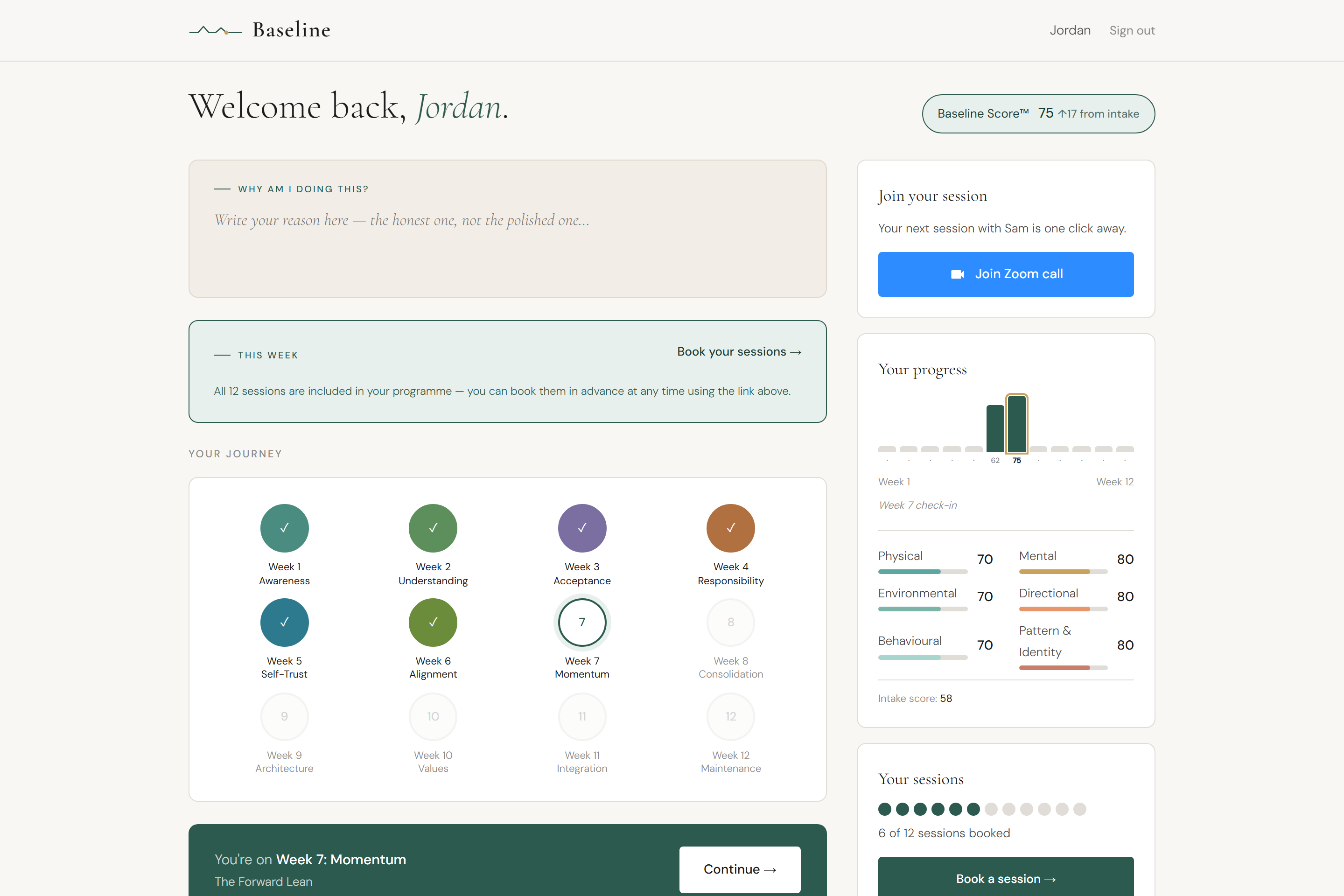
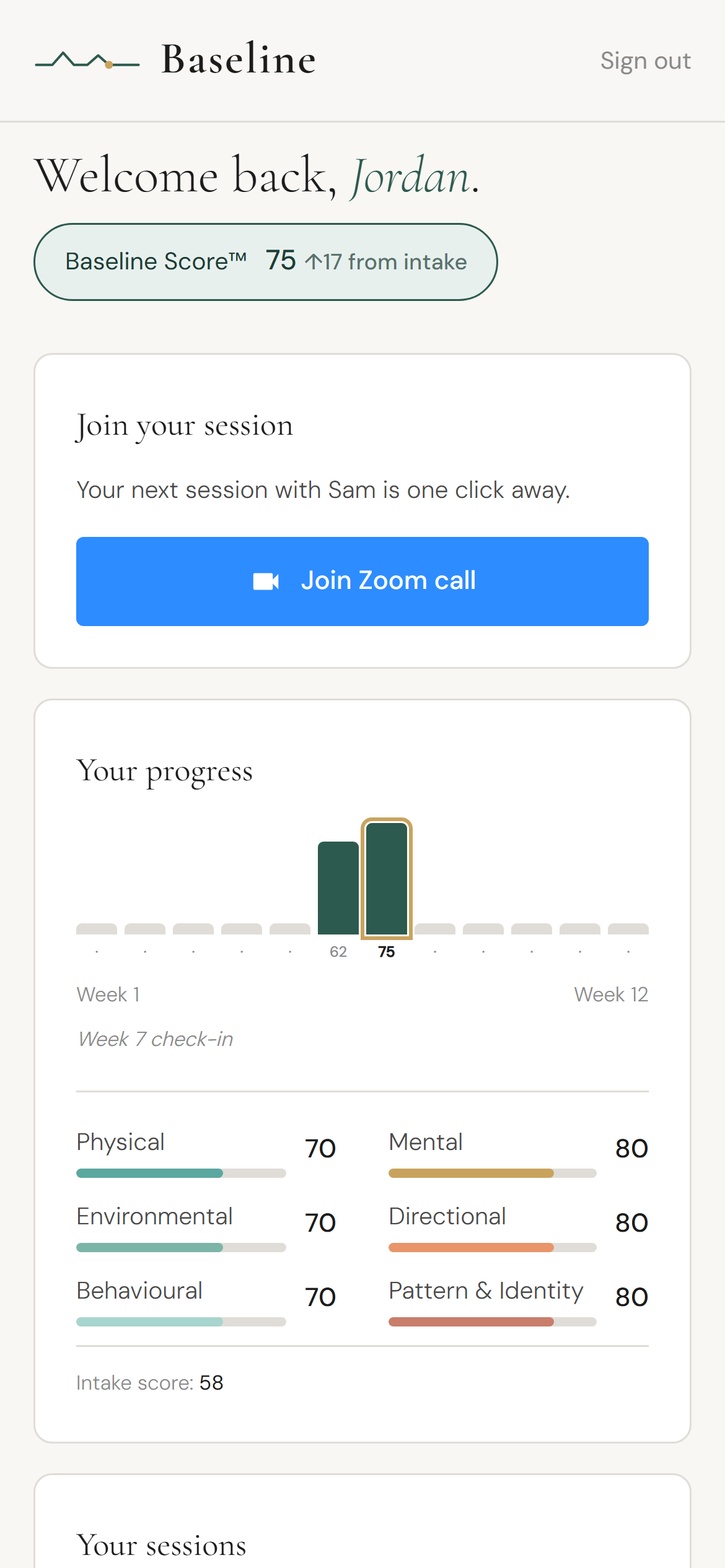
A structured 12-week 1:1 programme. We find what's driving the patterns that keep you stuck, work through them properly, and build something that actually holds.
We help capable people stop repeatingSam, Founder · Baseline Coaching
the patterns keeping them stuck,
and build something that lasts.
Most people arrive with something quieter than crisis: stuck, scattered, or unable to move forward despite everything they've tried. If any of these sound familiar, you're in the right place.
Twelve weekly 1:1 sessions. Three phases. One clear framework for operating at your best, built around you specifically, not a generic method.
A full inventory across every area of your life: patterns, beliefs, habits, environment. Most people find things here they've been too close to see.
We work through what's driving the patterns: where they came from, why they're still running, and what it actually takes to change them.
We build the framework you leave with: your values, your operating architecture, and a clear protocol for when life pulls you off course.
The full programme is explored on your discovery call. Structured, specific to you, and built to produce lasting change, not insight that fades.
30 minutes. You tell me what's going on; I explain how I work. Honest, no obligation. If it's the right fit, we'll talk about next steps.
Book now →One focused hour on a specific situation, decision, or stuck pattern. No commitment, no programme. Just targeted coaching where you need it.
The flagship programme. Twelve weekly 1:1 calls across three phases: The Audit, The Pattern Work, and The Operating System. Built around how you operate, designed for lasting change from the inside out.
Start with a discovery call →The Baseline Index™ covers 6 dimensions of your life: Physical, Mental, Environmental, Directional, Behavioural, and Pattern & Identity. 36 questions. A personalised score. A clear picture of exactly where the drift is happening before we do anything else.
Take the free Baseline Assessment →NLP is a practical study of how your mind builds the experience it does: the patterns of thought and behaviour you run, often without ever consciously choosing them.
Combined with a genuine psychology background, it becomes a grounded, precise toolkit. The goal: notice how you're thinking, not just what you're thinking, and change what isn't serving you.
NLP works from a handful of starting assumptions, not proven facts, but useful ones to build a session on. That you respond to your own map of the world, not the world itself. That the meaning of what you communicate is the response you actually get, never mind what you intended. That there's no such thing as failure, only feedback. That most people already have more of what they need than the stuck feeling lets on, including whatever's driving the pattern that looks self-defeating, which is usually trying to protect you somehow. And that mind and body run as one system, not two: change how you're holding yourself and your thinking shifts with it.
Every session works from the same underlying shape. Get honest about where you actually are now, including whatever's been keeping you there. Get specific about where you actually want to be, not the vague version. Then find or build whatever's missing to close that gap. It's the skeleton under most NLP work, and it's not a coincidence that it's also how the Baseline Reset itself is structured: the Baseline Index™ maps where you're starting from, the twelve weeks close the gap, and the Operating System you leave with is the desired state, written down and usable. NLP has a name for the loop running underneath all of it — test where you are against where you want to be, act, test again, stop only once it's actually true, not once it feels done. You don't need the acronym (TOTE, if you're curious) to recognise the shape. It's the same reason you retake the Index in week twelve instead of just taking my word for it that something's changed.
A good chunk of the actual craft is trained noticing, not talking: a shift in someone's breathing, skin tone, muscle tone, voice, the small physical tells that something's landed before a word's been said about it. Practitioners call this sensory acuity; really it's just paying very close attention. Reading someone's baseline closely enough to catch that shift is calibration. The trust that lets you match someone's pace before leading them somewhere new is rapport, and it's built, not assumed. What's actually being tracked throughout all of it is congruence: whether what someone's saying and what their body's doing agree with each other. Surface agreement without it rarely holds.
Language does the rest, in two opposite directions. Precise questions that surface what's actually been deleted, generalised or assumed underneath vague language (the Meta Model, from Richard Bandler and John Grinder's first book, The Structure of Magic, 1975) sharpen thinking. Looser, more permissive language does the opposite: the Milton Model speaks past conscious resistance towards the part of someone that's more resourceful than the stuck story suggests. It's modelled on the hypnotherapist Milton Erickson, one of a handful of exceptional therapists — Fritz Perls and Virginia Satir among the others — that Bandler and Grinder studied to work out what they were actually doing differently. NLP's working assumption is that the unconscious mind is fundamentally on your side, even when what it's running looks like self-sabotage, and that it answers to state, imagery and language more readily than to logical argument. Which is partly why insight on its own rarely changes much.
Worth being straightforward about: NLP isn't hard science. Some of its bigger claims haven't held up well under proper study, and I'm not going to tell you otherwise. What I actually use is the working model — the parts that hold up, session after session, in the room — filtered through an actual psychology background rather than a weekend certificate. If something about NLP sounds too tidy to be true, it probably is.
NLP maps your own patterns, not to influence someone else, but to give you real choice over your own thinking.
The only thing being worked on is your thinking: what's running on autopilot, and what you'd rather have running instead.
NLP isn't a solution for clinical conditions. If that support would serve you better, I'll say so directly.
Coaching is forward-focused and pattern-based. It complements therapy. It doesn't replace it.
That's a popular stretch of one small 1960s study (Mehrabian) about reading emotional ambiguity — tone and body language mattering more only when someone's words and feelings don't match. It was never a rule for all communication, and NLP doesn't treat it as one.
Tone and body language matter, especially when they contradict what's being said. But the real research doesn't support ignoring the words in favour of the body language, and I don't coach that way.
I grew up in Glasgow. When I was ten, my mum was diagnosed with cancer, and around the same time my dad left. Almost overnight, I became the "bad kid" - or the "weird kid," depending on who you asked. Restless, difficult to reach, impossible to settle. Nobody called it ADHD back then. They just called it a problem.
I learned early how to manage. How to perform. How to make it look like everything was fine when it wasn't. I got so good at it that for a long time, I didn't even notice I was doing it.
At twenty-one, with £5,000 and not much of a plan, I opened a coffee shop in Glasgow. Built it from the ground up, figured it out as I went, made something real out of nothing. It meant a lot to me. Then COVID hit, and it was gone.
I went back to study psychology - not for a career, but because I needed to understand myself. What made me tick. Why the same patterns kept repeating regardless of what I changed on the outside. What was actually happening underneath a surface I'd spent years perfecting.
At twenty-seven, my mum's cancer came back. She'd beaten it once. This time was different. I submitted my final assignment while she was still here. I managed to tell her I'd submitted it. I never got to tell her I passed. She died four days later.
I've hit rock bottom more than once. That part doesn't have a clean ending, and I'm not going to pretend it does. But what I have now, and what I didn't have for most of my life, is a baseline. A stable place to work from. Somewhere to return to when things get hard again, because they always do.
That's what this is. Not a story of having it all figured out. A framework built from the inside out, by someone who needed it badly enough to build it himself.
If you don't see your question here, use the chat or book a discovery call. I reply to every enquiry personally.
A free 30-minute conversation. You tell me what's going on. I'll explain how I work and whether this is the right fit.